
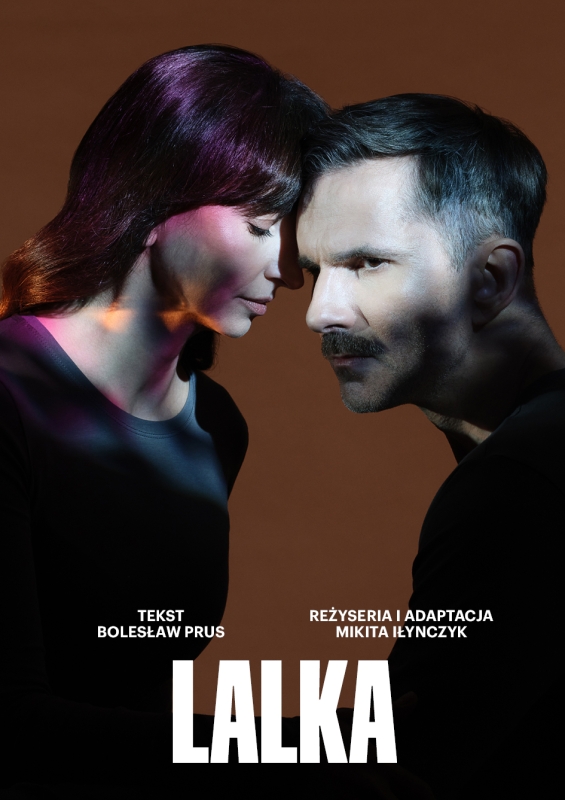
LALKA
Love, money, and social convention drive the narrative of Bolesław Prus's The Doll, a brilliant novel of ambition, social climbing, and disenchantment with the modern world. A penetrating account of a time when Warsaw became a scene on which ambitious dreams collided with ruthless mechanisms of class and society.
Director Mikita Ilyinchyk and dramaturg Goran Injac reinterpret the classic novel through the lens of late nineteenth-century politics—when Poland was partitioned, its people having to submit and adapt to foreign cultures. The creative team explore the experience of individuals living under the Russian yoke —in a world where the word “Poland” does not represent a community but a promise that cannot be fulfilled.
The production was inspired by an 1897 edition of The Doll handed down to the director. Heavily underlined in pencil, the book had belonged to the director's grandmother, a Polish citizen for the first six years of her life, until 1939. This heirloom serves as the interpretative frame for the show: Polishness is something that is not passed down by institutions but through memory and frustrated hope.
In this reading, the protagonist, Wokulski, is a figure whose biography exposes mechanisms of conformity and opportunism among the elites. Returning from exile in Siberia, he finds a world in thrall to the rouble, in which investors pin their dreams on the war industry. The nation he had risked his life for is embracing the new order to preserve its material status and a semblance of continuity. Wokulski is not part of this system: he probes its boundaries and bitterly exposes the ways in which class and capital have come to supplant moral values. Ilyinchyk's The Doll is a story about the desire for recognition and an attempt to find one's place in a world where every interaction is a test of one's social position and where closeness proves impossible in the face of class allegiance. The nineteenth-century setting offers a chance to examine social mechanisms that are seeing a resurgence today. Past and present are intertwined without pathos or sentimentality, to reveal a society overshadowed by imperial politics. Love becomes just another mechanism of social control.
directed and adapted for the stage by: Mikita Ilyinchyk
dramaturg: Goran Injac
set and costume design: Justyna Elminowska
music: Krzysztof Kaliski
lighting designer: Siarhei Rylko
stills: Tomek Pawlik
assistant to the director: Antonina Wąsowicz
assistant to the set designer: Kinga Kostoń-Hayatullah
choreographic consultation: Krystyna “Lama” Szydłowska
Cast: Waldemar Barwiński, Marcin Bosak, Mariusz Drężek,
Anna Gajewska / Małgorzata Witkowska, Katarzyna Herman, Robert T. Majewski, Małgorzata Niemirska, Marta Ojrzyńska, Agata Różycka, Piotr Siwkiewicz, Konrad Szymański, Mateusz Weber, Agnieszka Wosińska
| Date | Location | |
|---|---|---|
| 04-10-2026 17:00 | DRAMATYCZNY, Duża Scena | Buy ticket |
| 05-11-2026 11:00 | DRAMATYCZNY, Duża Scena | Buy ticket |
| 06-11-2026 11:00 | DRAMATYCZNY, Duża Scena | Buy ticket |
| 07-11-2026 19:00 | DRAMATYCZNY, Duża Scena | Buy ticket |
| 08-11-2026 18:00 | DRAMATYCZNY, Duża Scena | Buy ticket |
| 18-12-2026 19:00 | DRAMATYCZNY, Duża Scena | Buy ticket |
| 19-12-2026 19:00 | DRAMATYCZNY, Duża Scena | Buy ticket |
| 20-12-2026 17:00 | DRAMATYCZNY, Duża Scena | Buy ticket |

-
 PKiN, pl. Defilad 1
-
 602 792 282
-
 kasa@teatrdramatyczny.pl
-
PKiN, pl. Defilad 1
-
602 792 282
-
kasa@teatrdramatyczny.pl